In today’s business environment, intellectual property is more than just a legal asset. Patents, trademarks, copyrights, and industrial designs can all contribute to business growth, investor’s confidence, and long-term market positioning. IP valuation helps businesses understand the monetary value of these intangible assets so they can make better strategic and commercial decisions.
Understanding What IP Valuation Means
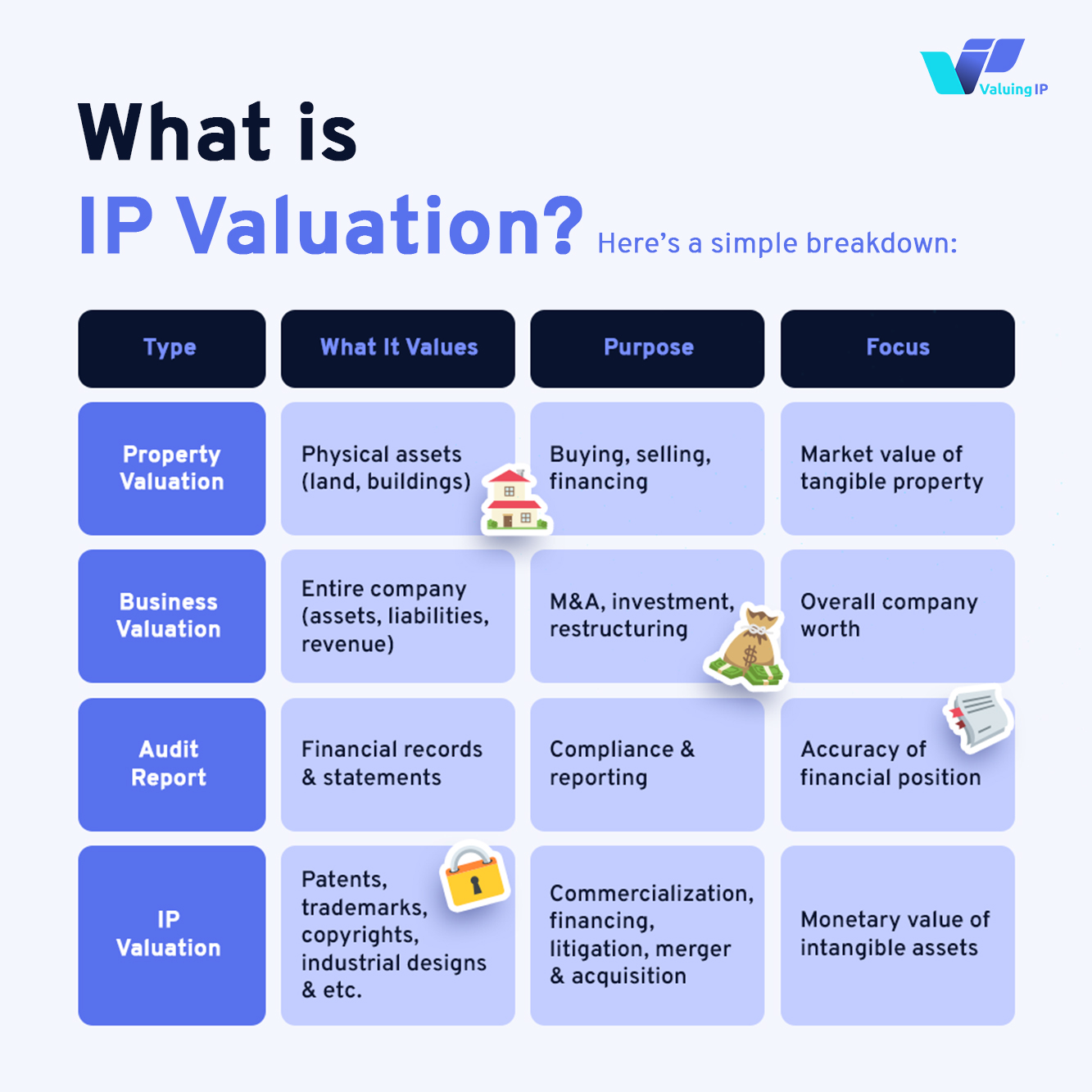
You can refer to the table below for a simple comparison of different valuation types, including IP valuation and how it differs from property valuation, business valuation, and audit reports.
Why IP Valuation Matters to Businesses
IP valuation is not just a technical process, it is a practical business tool. When a business understands the value of its intellectual property, it can make stronger decisions about funding, negotiation, protection, and long-term strategy.
A company may already own valuable inventions, branding, creative works, or designs, but without knowing their market value, it may not use them effectively. This can lead to weaker negotiations, missed commercial opportunities, and poor prioritisation of assets.
Why businesses need IP valuation
- Financing & Fundraising — helps strengthen investor confidence
- Commercialisation — helps businesses license, sell, or monetise IP more effectively
- Litigation — helps quantify damages and support fair dispute resolution
- Corporate Strategy — helps identify high-value IP assets
- Mergers and Acquisitions — helps assess the true value of a business more accurately
What Businesses Can Gain From Proper IP Valuation
A proper IP valuation does more than assign a figure to an asset. It helps businesses gain clearer insight and create stronger commercial advantages.
Valuation Outcomes:
- identify the contribution of IP assets to overall enterprise value
- determine the individual market value of each IP asset
Commercial Outcomes:
- enables IP-backed financing
- validates the commercial potential of IP
- strengthens positioning in mergers and acquisitions (M&A)
- support licensing, technology transfer & commercialisation strategies